

The waiting is visible. The acceptance decision often is not.
A report takes long enough to interrupt a planning meeting. Users export it and continue in a spreadsheet, while the engineering team proposes a cache or a faster calculation. Everyone agrees that waiting is a problem. The difficult decision is what the business is willing to accept in exchange for a quicker answer.
This is a hypothetical situation, not a client incident. A report can arrive sooner because the system avoids unnecessary work. It can also arrive sooner because it returns older data, skips an exception or uses a different aggregation. Those changes may be reasonable, but they are not interchangeable. Before approving the work, a product leader needs a measured constraint and an explicit statement of what must remain true.
Find the constraint before choosing the remedy
The slow part might be repeated database reads, computation, waiting for a lock, rendering or a large response travelling to the client. The same visible delay can therefore require very different changes. A cache does not automatically resolve contention, and a faster query does not necessarily make the screen usable sooner.
Django's optimization guidance recommends profiling before a change and measuring again afterward, with attention to the trade-offs between speed, memory and complexity. PostgreSQL's EXPLAIN documentation adds a useful boundary: a query plan is not a complete user-journey measurement. Its estimated costs are not elapsed time, and EXPLAIN ANALYZE does not include transmission of results to the client. These are source-backed limits on what a measurement can demonstrate, not instructions to use a particular framework.
Our recommendation is to define the journey in business terms first: a person changes an input, requests the report and receives a result they can use. Measure that path, then use narrower traces to locate the work responsible for the delay. Record the input snapshot, workload and environment so the next comparison answers the same question.
“Same result” needs a definition
Comparing the headline total is a useful start, not a complete contract. A change may preserve the total while altering detail rows, exception handling, permissions, rounding or the moment at which a result becomes current. A comparison should cover the outputs and side effects that people actually rely on.
Numerical changes deserve particular care. Python's decimal documentation demonstrates that limited precision can make arithmetic results depend on grouping; decimal representation alone does not remove every rounding issue. This does not mean every implementation must preserve every intermediate operation forever. It means that an intentional numerical change needs an owner and a justified acceptance rule, rather than an unexplained difference dismissed as noise.
A baseline also has limits. Matching an existing implementation shows agreement with that implementation; it does not independently prove the business rule is correct. If the baseline contains an error, document the correction separately. Otherwise, a legitimate product change can disappear inside a project described as performance work.
The business cost is an answer people cannot trust
Delay can create manual work and postpone decisions. An unexplained answer can create a different burden: someone must reconcile reports, decide which result to trust and explain the discrepancy to colleagues. The cost depends on the product and on the decisions people make with its reports.
That is why acceptance should have two gates. The candidate must improve the measured constraint enough to justify its added complexity, and it must satisfy the agreed result, side-effect and freshness requirements. A deliberate trade-off can pass those gates when the business understands it. An undocumented trade-off cannot.
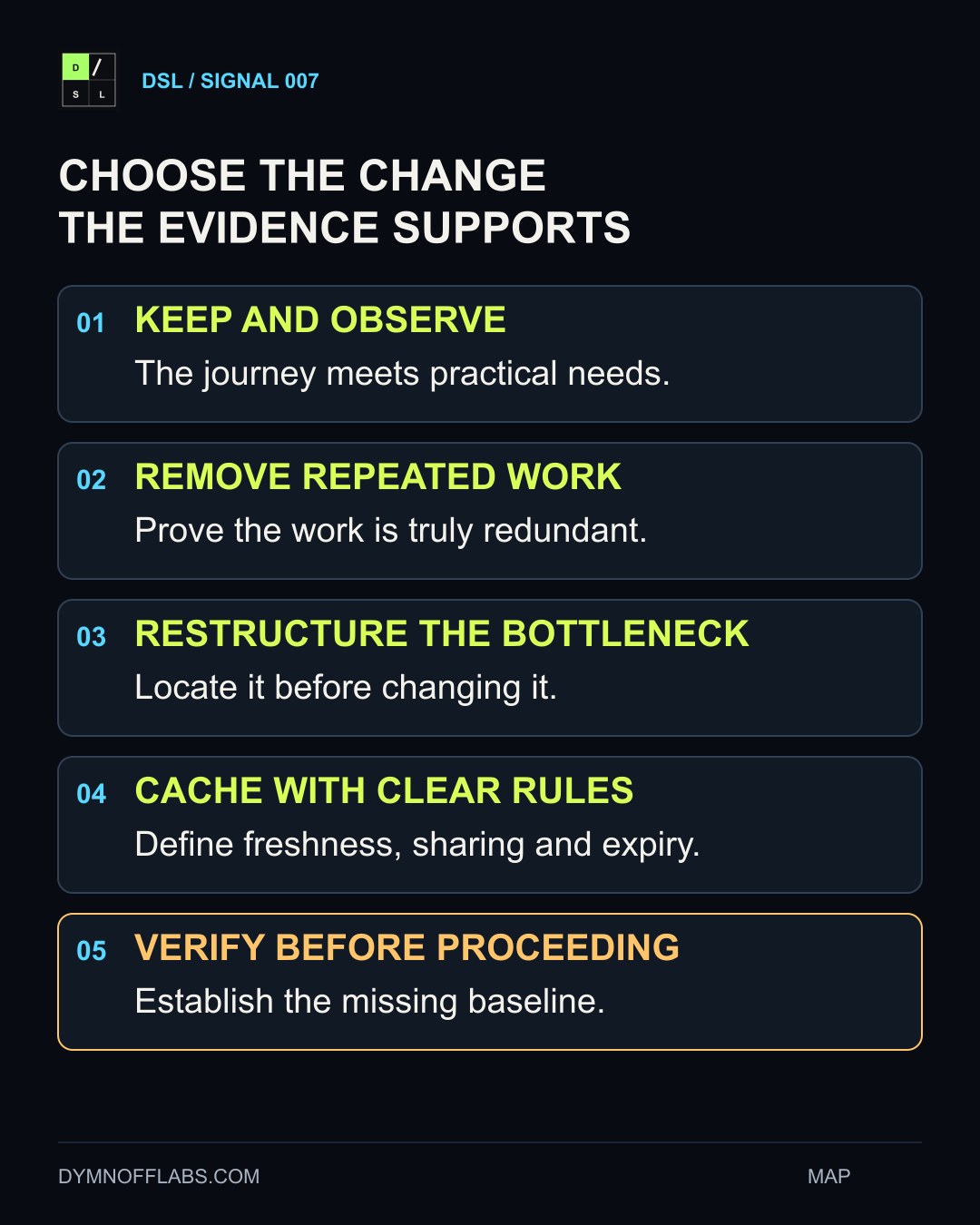
Choose the smallest intervention the evidence supports
The following map is our recommendation, not a vendor standard or an exhaustive list of implementation techniques.
Keep and observe when the journey meets its practical needs and a meaningful constraint has not been demonstrated. A complicated optimization has a maintenance cost even when it is technically interesting.
Remove repeated work when traces show unnecessary reads or recomputation. Verify that the work was genuinely redundant rather than responsible for freshness, authorization or an expected side effect.
Restructure the measured bottleneck when evidence identifies a specific query or calculation. Batching or moving work can help, but compare transaction behavior, detail outputs and numerical rules as well as runtime.
Cache deliberately when the product can accept a defined freshness boundary. Specify what makes an entry invalid, which users or contexts may share it, and who owns that contract. “It is cached” is an implementation description, not an answer to how current the report must be.
Defer the intervention when the result contract or representative measurement is missing. First establish those foundations, or separate an intended rule correction from behavior-preserving work. Deferral here is a bounded evidence task, not permission to leave a serious user problem unattended.
What to verify in the first five to seven days
During the first two days, choose one important journey and agree its timing and freshness needs with the person responsible for the business outcome. Capture a reproducible input snapshot and representative outputs, including empty cases and exceptions. State which differences are permitted and who can approve them.
During days three and four, profile a representative non-production setup and select one bounded intervention. Keep baseline and candidate conditions comparable. EXPLAIN ANALYZE actually executes the query, including its side effects; it is not harmless inspection. Use a safe copy rather than experimenting on production without an approved procedure.
During days five to seven, investigate every unexplained difference and repeat the measurements. Include cold and warm state where relevant, realistic data size and competing work. Report the user-journey result alongside narrower component measurements. Record the environment, remaining limitations, operating owner and route back if acceptance fails. These are recommended review activities, not a promise that every optimization can be completed in one week.
When an independent review helps
External review is useful when teams disagree about where the time goes, nobody can explain the comparison baseline, or a proposed cache changes the product's freshness promise without a clear owner. It should produce a bounded decision and the evidence needed to make it, rather than a generic instruction to rewrite the system.
At Dymnoff Software Labs, this is a modernization and technical-audit question: identify the constraint, make the product contract explicit and choose work that can be verified. Discuss a review of one slow, business-critical calculation , with the result people rely on and the delay they experience. The useful deliverable is a justified intervention and acceptance plan, not a promised speedup.
Approve the improvement when both the waiting and the answer have been checked.
Technical notes and primary sources
- Django: Database access optimization — profiling and context-dependent trade-offs.
- PostgreSQL 18: Using EXPLAIN — planner estimates, actual execution and measurement boundaries.
- Python: decimal floating-point notes — precision and arithmetic-order caveats.
Sources support the technical distinctions. The buyer scenario, two acceptance gates, decision map and first-week plan are editorial synthesis and recommendations. No production experiment, client incident or performance outcome is asserted.