
The symptom: a small feature arrives with a large operating bill
A buyer asks for accounts, payments, live tracking, an AI assistant, or another notification channel. The interface change looks contained, the estimate is framed as a few screens and endpoints, and the roadmap gains an attractive capability. Six months later, the team is maintaining identity recovery, provider disputes, stale data, access controls, incident paths, and support scripts that were never included in the original decision.
The problem is not that the feature was implemented badly. The product accepted a responsibility without deciding whether it wanted to own the corresponding failure mode.
Architecture is therefore shaped not only by what a product can do, but also by what it explicitly declines to do. That boundary is commercially important. It determines which promises can be made, which incidents must be handled, which controls need evidence, and which costs remain after the launch project is over.
What sits underneath the request
Every consequential feature creates an obligation chain. An account adds identity proof, session security, recovery, deletion, and support. Payments add provider integration, entitlement state, refunds, disputes, reconciliation, and compliance scope. “Real-time” data adds freshness contracts, monitoring, degradation behavior, and an operating owner. An AI answer adds source quality, provenance, excluded actions, and a way to handle confident but unsupported output.
Standards describe parts of the same engineering logic. NIST’s least-functionality control recommends limiting a system to mission-essential capabilities because combining unnecessary services increases risk. The GDPR requires personal data to be limited to what is necessary for a stated purpose and, by default, limits the amount, processing, retention, and accessibility of that data. PCI Security Standards Council guidance explains that segmentation can reduce the number of systems in payment-security scope, while weak boundaries can pull connected systems back into scope. AWS’s shared-responsibility model makes a related point: using a provider changes the work a customer owns, but does not make responsibility disappear.
These sources do not produce a universal product formula. Together, they support a practical conclusion: scope is an operating decision, not only a feature-list decision.
The business consequence of accidental ownership
Unexamined responsibilities create costs that are easy to miss in a delivery estimate.
- A launch date depends on controls, provider approval, migration, or recovery work that was not part of the feature brief.
- A vendor removes implementation work but leaves configuration, integration, evidence, and customer support with the product team.
- Data collected “for later” creates retention, access, deletion, and breach obligations before it creates customer value.
- A capability coupled to the main system expands the blast radius of failures and the scope of every audit or incident review.
- Support inherits promises that engineering cannot verify from production evidence.
The cost of delay is not simply more technical debt. Once customers, sales material, contracts, and internal processes depend on the feature, removing or narrowing it becomes a commercial negotiation. The cheapest moment to refuse the wrong responsibility is before it becomes part of the product’s identity.
A decision map: own, minimize, isolate, delegate, or refuse
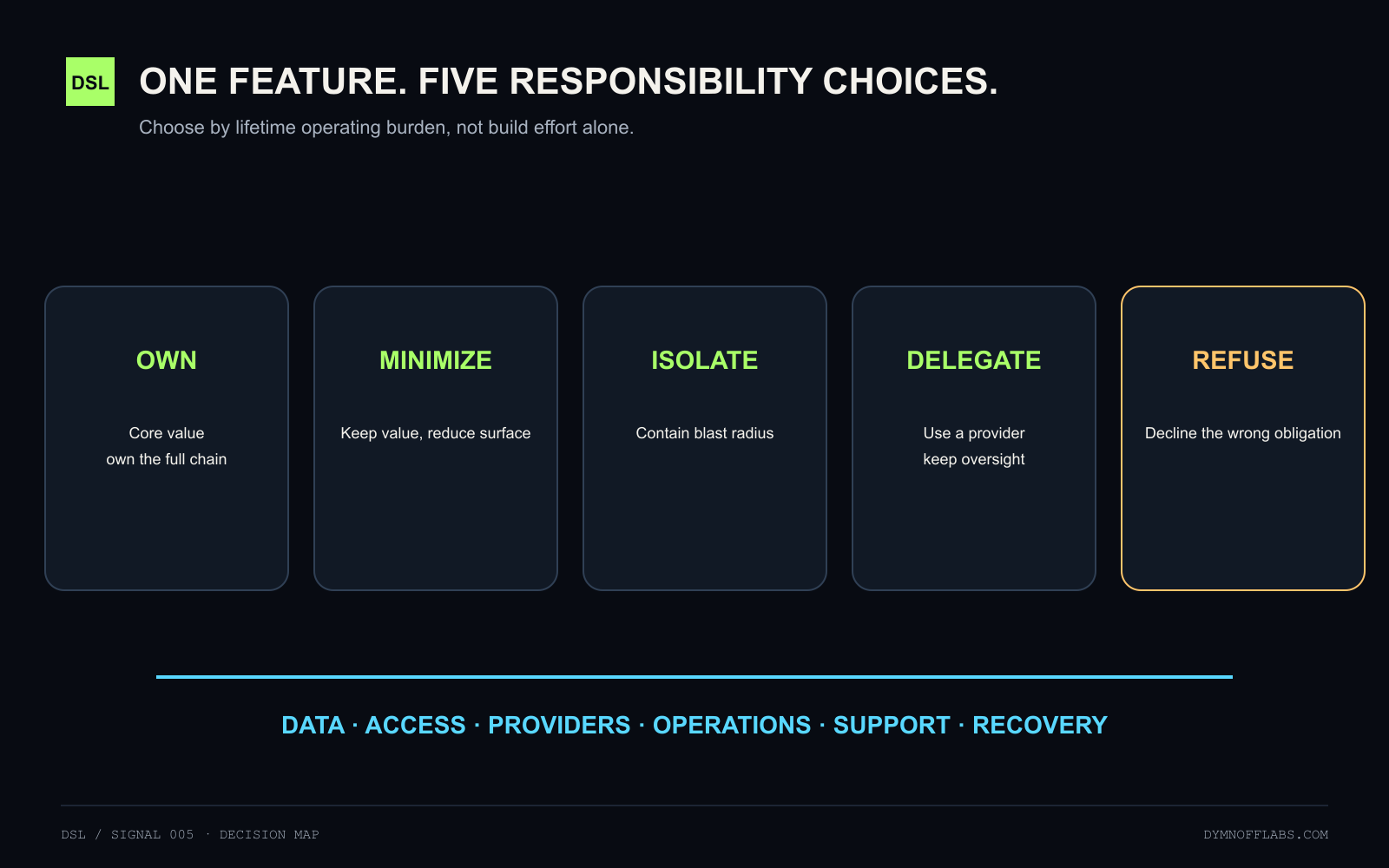
Before approving a material capability, choose one of five positions.
- Own it. Accept the responsibility when it is central to the customer outcome and the product can fund the complete lifecycle: delivery, security, observability, recovery, support, and change.
- Minimize it. Keep only the smallest data set, permission, workflow, or service level needed for the outcome. A narrower commitment is easier to test and operate.
- Isolate it. Put the capability behind a clear boundary when it must exist but should not spread its risk, data, privileges, or release dependency across the whole product.
- Delegate it. Use a provider when its managed capability reduces real work, while documenting what the provider owns, what the product still owns, how failure is detected, and how exit or substitution works.
- Refuse it. Decline a capability when it creates an unwanted trust, custody, regulatory, operational, or support obligation that is not necessary for the product outcome.
Three current product boundaries make the distinctions concrete. STM Balance works without an account or project backend and keeps its application data locally; it deliberately avoids uploading card data to its own server. Block Beagle analyzes public blockchain activity but permanently excludes custody, private keys, signing, broadcasting, and moving funds. HailMe takes the opposite position where the product outcome requires it: its arrival-alert service owns a backend, authenticated state, delivery channels, and the operational paths that connect them.
These are not prescriptions for every product. They show why “more capability” and “better architecture” are not synonyms.
What to verify in the first five to seven days
Choose one proposed feature or one existing capability that regularly causes delivery or support friction. Write the customer outcome first, without naming a technology. Then map the responsibility chain.
Record the data the capability collects, the privileges it needs, the external providers it depends on, the authoritative state, the failure and recovery paths, the evidence available in production, and the team that can make cross-boundary decisions. Include deletion, migration, provider outage, user denial, duplicate events, and stale-data behavior where relevant.
Next, separate confirmed facts from assumptions. A provider’s marketing page is not evidence that the integrated journey works. A successful demo is not evidence of recovery. A roadmap item is not an operating owner. Reproduce the critical path, inspect the real configuration, and identify what happens when each boundary fails.
Finish by applying the five-way map. State what the product will own, what it will minimize, what needs isolation, what is delegated with retained responsibilities, and what it will refuse. Turn each accepted responsibility into an evidence gate for release and a named operating owner.
When an external architecture audit is justified
An external review is useful when a “small” feature crosses identity, payments, sensitive data, third-party providers, AI decisions, or multiple delivery teams; when the same failure repeatedly appears in different forms; when a vendor boundary is treated as if it removed accountability; or when nobody can explain which system is authoritative and who recovers the journey.
The useful deliverable is not a diagram of the current stack. It is a responsibility map tied to buyer commitments: accepted obligations, deliberate exclusions, failure paths, evidence gaps, owners, and a sequence for reducing risk without funding a broad rewrite.
Dymnoff Software Labs uses this boundary review in technical audits, modernization, and product recovery work. If the next roadmap decision adds more operational responsibility than the estimate acknowledges, the first step is to audit the obligation chain before implementation begins.
Technical notes and primary sources
Confirmed product facts come from the current HailMe, STM Balance, and Block Beagle project documentation reviewed on 21 September 2026. The five-way decision map and the application of these principles to product planning are DSL editorial recommendations.
- NIST SP 800-53 Rev. 5.1, CM-7 Least Functionality — limiting systems to mission-essential capabilities and restricting unnecessary functions and services.
- EUR-Lex: General Data Protection Regulation, Articles 5 and 25 — purpose limitation, data minimisation, and data protection by default.
- PCI SSC: Guidance for PCI DSS Scoping and Network Segmentation — how boundaries and segmentation affect the number of systems in security scope.
- AWS Shared Responsibility Model — responsibilities vary by service choice and remain divided between provider and customer.
- NIST SP 800-218: Secure Software Development Framework — tracking security requirements, risks, design decisions, and software provenance.