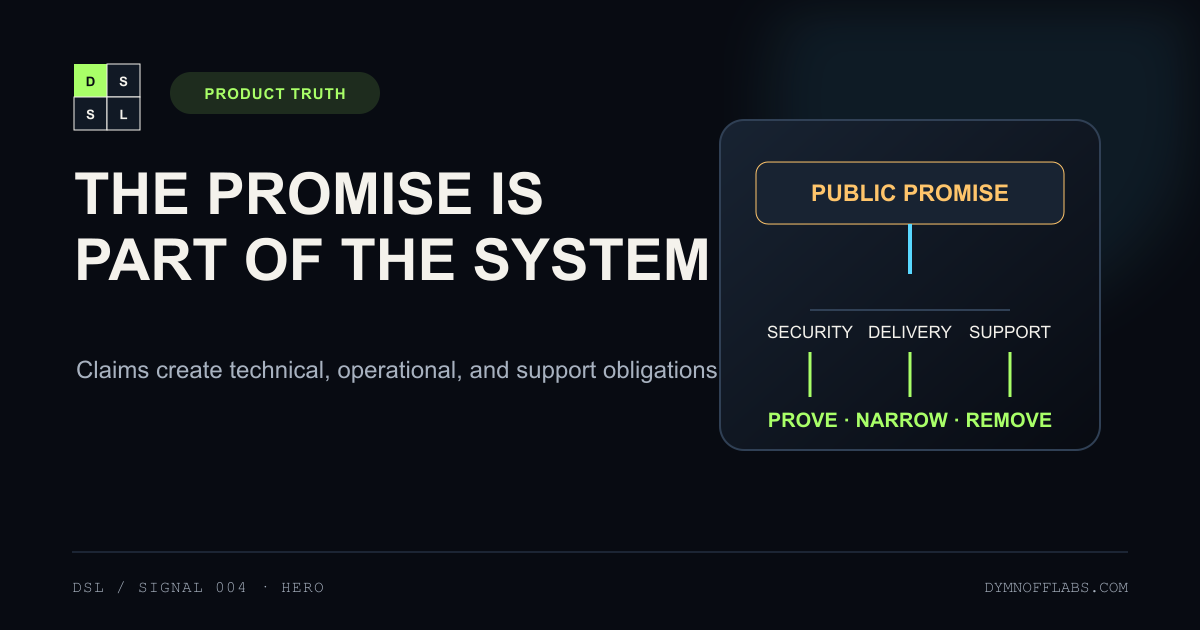
The symptom: the page sells one product while the system ships another
A landing page calls a service a wallet. The product itself only reads public blockchain data. No private keys are accepted, no transactions are signed, and no funds are held. To a marketing team, changing “wallet” to “read-only analysis” can look like shrinking the offer. To a product leader, it should look like removing obligations the system was never designed to carry.
This kind of mismatch is common in young and inherited products. Early copy is written around an ambition; engineering then ships a narrower, safer path; sales material, onboarding, pricing, support scripts, and interface labels keep the original promise. Each surface may be individually plausible, yet together they describe a product that does not exist.
The first question is therefore not “Can we phrase this more carefully?” It is “What would a reasonable buyer believe the product can do, and can we prove that behavior end to end?” The FTC evaluates both explicit and implied claims in context, and says objective advertising claims need evidence before publication. That is a useful product discipline even outside US legal scope.
What sits underneath the mismatch
A material product claim is a compact architecture statement. “Wallet” implies some way to control an account, sign or initiate actions, protect sensitive credentials, recover access, and support failures. “Real-time monitoring” implies a data source, refresh contract, worker or event path, freshness indicator, alert policy, delivery evidence, and an operating owner. “Enterprise-grade security” implies controls and verification that go beyond a login screen.
The gap usually survives because nobody owns the complete chain. Marketing owns the sentence, product owns the roadmap, engineering owns implemented behavior, operations owns the running system, and support owns the user’s interpretation after something fails. Without one claim register, each group can be locally correct while the public product remains globally false.
Block Beagle offered a concrete example during a product-truth review. Its defensible boundary was read-only blockchain intelligence: inspect addresses and transactions without holding keys, signing, broadcasting, or moving funds. Ethereum’s own documentation makes that distinction consequential: control of private keys enables account activity and transaction signing, while a read operation does not modify blockchain state. Removing wallet and protection language was not cosmetic caution. It aligned the promise with the trust boundary the product actually owned.
The business cost of leaving the promise in place
An unsupported promise does more than create reputational risk. It pulls the roadmap toward obligations that may not belong in the product.
- Sales qualifies prospects against capabilities that cannot be demonstrated reliably.
- Support inherits questions and recovery expectations the system cannot satisfy.
- Engineering receives “small” feature requests that actually require new identity, custody, data, security, or operational models.
- Security reviews start from the wrong threat model because the public description implies assets or actions the system does not handle.
- Buyers discover the boundary late, when trust is most expensive to repair.
The cost of delay grows because new UI, documentation, integrations, and contracts begin to depend on the inflated description. A roadmap item quietly becomes a current commitment. A disclaimer placed near the bottom rarely repairs a headline whose ordinary meaning points in the opposite direction.
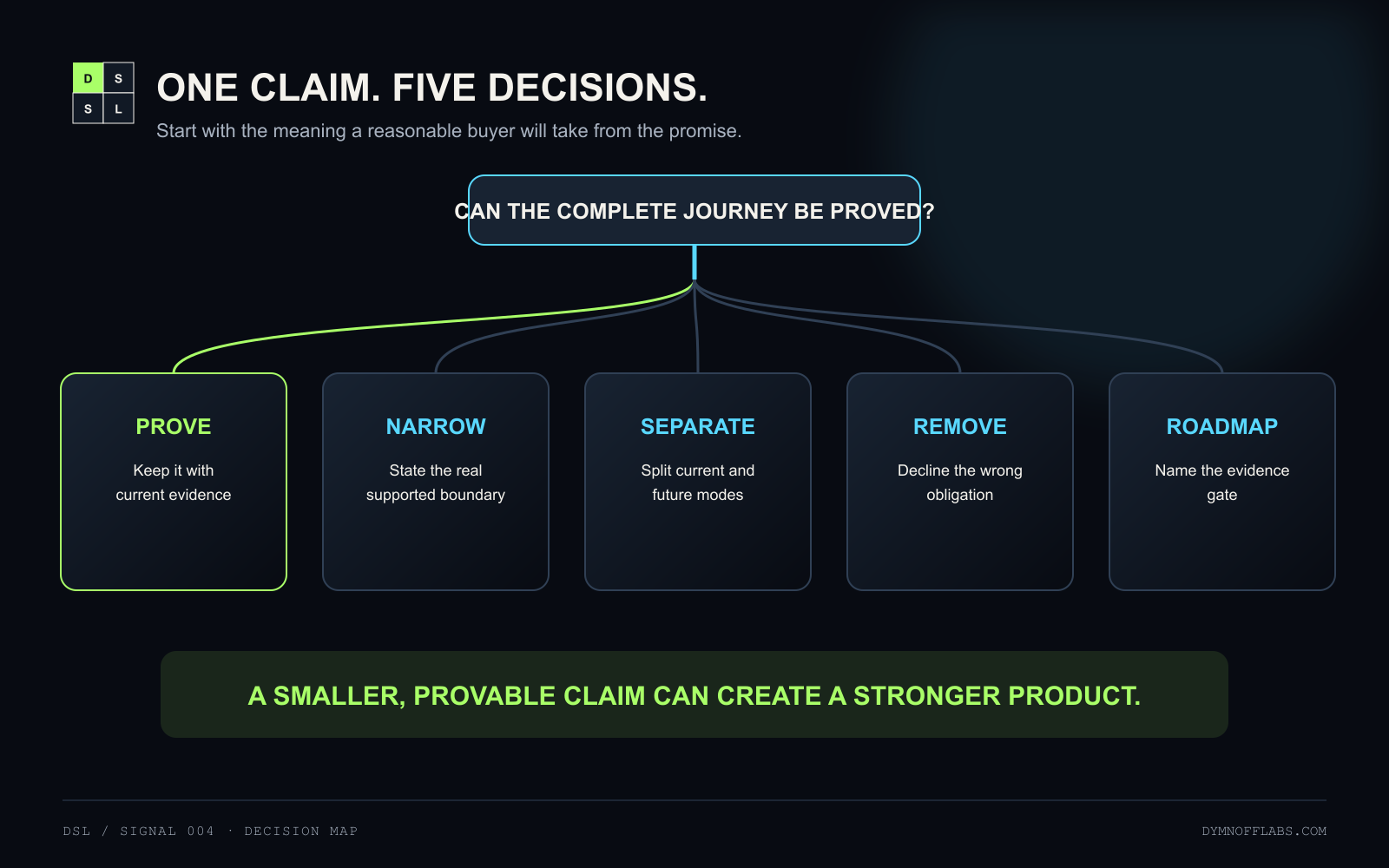
A decision map for every high-risk claim
Review the claim as a product commitment, then choose one of five paths.
- Prove it. Keep the claim when a user can complete the promised journey, the failure states are understood, the operating owner is named, and evidence is current.
- Narrow it. Preserve the useful part while stating the real boundary: “Ethereum address analysis” instead of “manage all crypto assets,” or “periodic snapshots” instead of “real time.”
- Separate it. When one mode is supported and another is not, split the surfaces, plans, or labels so that a limited capability does not imply a broader one.
- Remove it. Delete wording that creates an unwanted trust, custody, security, or service obligation. Removal can be the highest-value product decision.
- Mark it as roadmap. Future capability may remain visible only when the page clearly distinguishes it from what a buyer can use today and someone owns the acceptance evidence required to promote it later.
This map is not a request to make every sentence timid. Specific, evidenced claims are usually stronger than broad ones. “We never accept private keys or sign transactions” tells a buyer more than “secure blockchain platform,” while also giving engineering and support a testable boundary.
What to verify in the first five to seven days
Start with the ten claims most likely to change a purchase, security review, integration decision, or support expectation.
For each claim, record the exact public wording and the interpretation a reasonable buyer is likely to take from it. Trace that interpretation through the shipped interface, API, data sources, permissions, failure states, support path, and operating ownership. Attach evidence: a reproducible journey, test, production configuration, runbook, or measured service behavior. A roadmap document by itself is not evidence that a capability is available.
Then classify the claim as supported, partial, roadmap, removed, or unknown. Assign a review trigger, because claims drift as code, providers, pricing, and operations change. NIST’s Secure Software Development Framework supports the same underlying discipline: document requirements, track risks and design decisions, and preserve provenance for releases. The claim register becomes the product-facing view of that evidence.
Finish the week by correcting the highest-consequence mismatch across every surface, not just the homepage: metadata, screenshots, onboarding, pricing, product UI, sales material, and support guidance. Otherwise the old promise continues to travel through a different route.
When an external product-truth audit is justified
An external review is useful when a launch, sale, investment review, security assessment, or major integration depends on claims that cross several teams; when current and roadmap capabilities are mixed together; when nobody can name the source of truth; or when removing a promise creates internal resistance because it appears to reduce commercial value.
The deliverable should not be a vocabulary cleanup. It should connect each material claim to shipped behavior, evidence, trust boundary, operating owner, and remediation decision. Where the product cannot support the promise, the reviewer should show whether the right move is to narrow the claim, change the system, isolate a risky capability, or deliberately decline the responsibility.
Dymnoff Software Labs uses this evidence-led boundary review inside technical audits and product recovery work. If an upcoming commitment depends on capabilities that are difficult to prove, the practical first step is to audit the promise-to-system chain before funding more implementation.
Technical notes and primary sources
Confirmed facts in this issue come from the Block Beagle support matrix and claim registry, checked against the project source on 7 September 2026. The wider decision framework is an editorial recommendation from DSL, not a claim that every wording mismatch has the same legal or technical consequence.
- FTC: Advertising FAQ for small business — explicit and implied claims, materiality, and substantiation.
- NIST SP 800-218: Secure Software Development Framework — documented requirements, risk and design decisions, and software provenance.
- CISA: Secure by Design principles — transparency, accountability, and ownership of customer security outcomes.
- Ethereum.org: Ethereum accounts — private keys, account control, and transaction signing.
- Ethereum.org: Interacting with smart contracts — the operational distinction between reading state and signed state-changing transactions.